Walk through almost any historic Italian garden and you will meet the same five plants. They appear in grand villas and modest courtyards, along driveways and beside kitchen doors. Box, cypress, olive, citrus, and wisteria are not random ornament; they are the bones, scent, and colour of a particular way of gardening. You do not need a botanist’s notebook to tell them apart. Look at the whole plant first, then the leaves, bark, flowers, and the place where it grows. These clues usually settle the question.
Why These Five Plants Define Italian Gardens
Italian gardens are often described as architectural, and these five plants are the reason. Box supplies the clean lines. Cypress gives the vertical accent that makes a flat landscape feel dramatic. Olive brings a silver shimmer and a link to the agricultural countryside. Citrus adds glossy leaves and perfume in sheltered places. Wisteria provides the soft explosion of colour that breaks up all that evergreen discipline.
You see them repeated because they work. They tolerate the climate, respond well to pruning, and have been used for centuries in villas, monasteries, and family gardens. Once you know their basic shapes and textures, an Italian garden becomes easier to read.
Box: The Quiet Geometry
Box, usually Buxus sempervirens, is the plant that draws the garden’s plan. It is an evergreen shrub with small, opposite leaves that feel firm and glossy. The leaves are oval to rounded, often with a slightly notched tip. Crush one leaf and you will notice a distinct, slightly musty green smell—one of the quickest confirmations.
What to look for
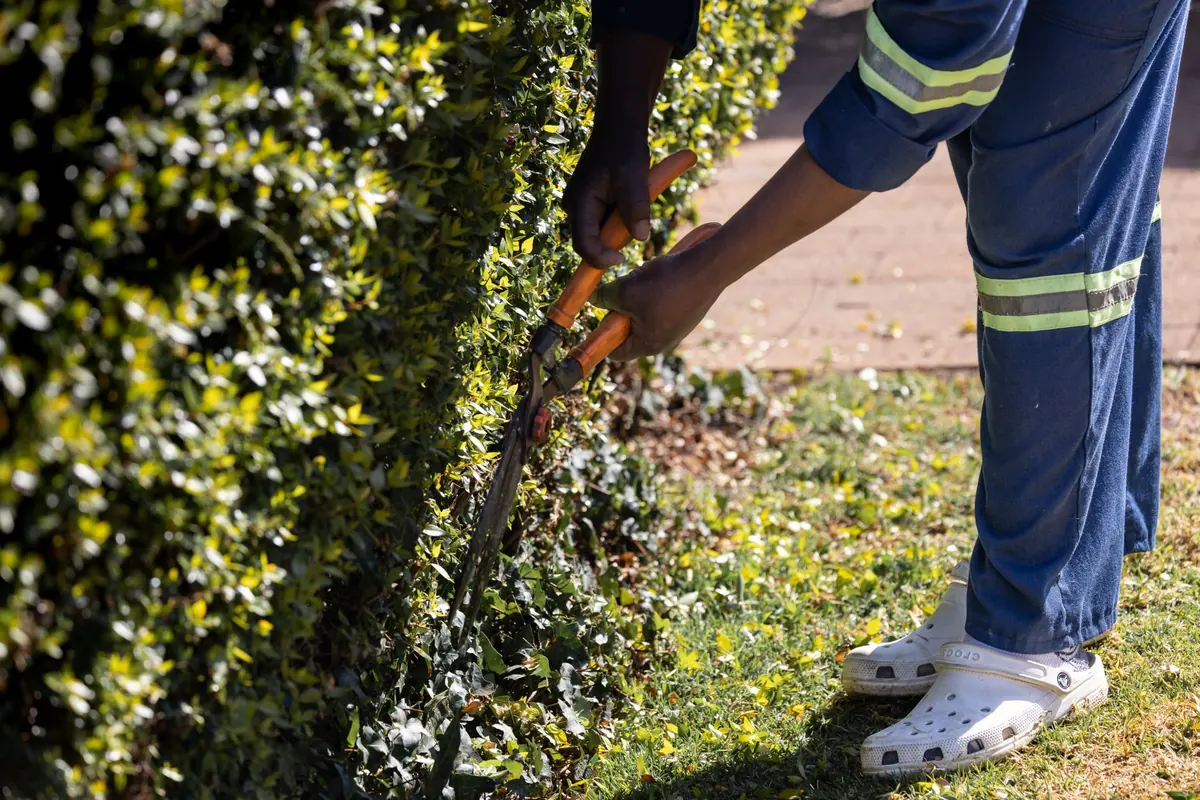
From a distance, box reads as a tight green cushion or a crisp low hedge. Up close, new growth is lighter and older foliage darker. The stems are square-ish when young. Box is often clipped into balls, cones, borders, and animal shapes, so the outline is more informative than a single leaf.
Traditional role
Box creates parterres, knot gardens, edging for flower beds, and container specimens beside steps. If you see a low hedge clipped with sharp corners and a dense, compact habit, box is a strong candidate. Compare it with privet, which has alternate leaves and a less rounded shape; box leaves sit in opposite pairs.
Italian Cypress: The Vertical Signature
Italian cypress, Cupressus sempervirens, is the tall dark-green column that appears on hilltops, along cemetery walls, and at the end of long garden paths. Its silhouette is almost unmistakable: narrow, upright, and slightly tapered, like a brush standing on end. The foliage is made of tiny scale-like leaves pressed close to the twigs.
What to look for
Step back and look at the whole shape. Italian cypress usually stays much narrower than other evergreens of similar height. The colour is deep green, sometimes with a greyish cast. Small round cones appear on mature trees. Do not identify it from a single sprig; the columnar habit is the main clue.
Traditional role
Cypress frames views, marks entrances, lines avenues, and gives shelter from wind. It also has a strong association with memory and cemeteries in Italy. In a garden, a pair of cypresses often flanks a gate or a flight of steps. A tall, narrow evergreen standing alone like a dark exclamation mark is probably Italian cypress.
Olive: The Silver Canopy
The olive, Olea europaea, is easier to recognise by atmosphere than by any single feature. Its leaves are narrow and leathery, dark grey-green on top and pale silver underneath. When the wind turns them, the whole tree flickers between green and silver. The trunk is often gnarled and twisted, and the bark is grey-brown and rough.
What to look for
Olive leaves grow in opposite pairs along the shoot. They are much narrower than box or citrus leaves and have a muted, dusty look. Small white flowers appear in spring, followed by green fruit that turns dark. The tree’s habit is rounded and open, not tightly clipped.
Traditional role
Olives belong to the agricultural landscape as much as to the ornamental garden. They are grown in groves, on terraces, in courtyards, and increasingly in large pots. A useful identification tip: compare the leaf’s pale underside with the darker top. That contrast is one of the olive’s signatures.
Citrus: The Fragrant Ornamental
Citrus—lemon, orange, mandarin, and their relatives—makes a sheltered Italian courtyard feel like a small paradise. The leaves are glossy, evergreen, and usually oval with a slightly pointed tip. Many citrus leaves have a faint winged stalk at the base. Crush a leaf and the clean, sharp citrus scent is often enough to confirm the genus.
What to look for
White, star-shaped flowers with a strong perfume are a good sign, especially in spring. Fruit may be present at the same time as flowers. Citrus leaves are usually darker and glossier than olive leaves, and the plant’s habit is more shrubby or small-tree-like. In northern Italian gardens, citrus is often grown in terracotta pots and moved under cover for winter.
Traditional role
Citrus has long been a status symbol in Italian gardens: a sign that the owner could provide shelter, sun, and careful watering. It appears in courtyards, against south-facing walls, and in special winter houses called limonaie. If you see a glossy evergreen in a pot near a protected wall, with white flowers or bright fruit, test the leaf scent.
Wisteria: The Flowering Cascade
Wisteria is a woody climber, not a shrub or tree, and that habit is the first clue. It twists its stems around pergolas, railings, and tree trunks, sometimes becoming thick and rope-like with age. The leaves are compound, made up of several oval leaflets arranged along a central stem. In late spring, long drooping clusters of pea-like flowers hang down in shades of lilac, purple, or white.
What to look for
Look for the flowers first: they hang in racemes, often 20–30 cm long, though length varies. After flowering, flat green seed pods may develop. The stems twine around their support; they do not cling with tendrils. Old wisteria can produce a thick, twisted trunk. Do not confuse it with laburnum, which has yellow flowers and grows as a tree, or with grapevine, whose leaves are lobed rather than divided into leaflets.
Traditional role
Wisteria covers pergolas, arches, façades, and garden walls. It softens the hard lines of stone and stucco and provides dramatic seasonal colour. It needs strong support and regular pruning, and it can damage gutters or roof tiles if planted too close to a building. A vine with hanging purple flower clusters and compound leaves is wisteria.
A Simple Identification Walk
Use a fixed order when you are unsure. It stops you from jumping to a conclusion based on one leaf or one flower.
- Look at the habit. Is it a low clipped hedge, a tall column, a rounded tree, a potted shrub, or a climbing vine?
- Check the leaves. Are they opposite or alternate? Simple or compound? Glossy or dull? Green or silver?
- Use your nose. Crush a single leaf from a plant you are allowed to touch. Box, citrus, and olive each have distinctive scents.
- Examine the bark and stems. Gnarled grey bark suggests olive; square young stems and dense twigs suggest box; rope-like twisting stems suggest wisteria.
- Note flowers and fruit. White citrus blossom, olive fruit, cypress cones, and wisteria racemes are all strong signals.
- Read the setting. A potted glossy evergreen near a sheltered wall is likely citrus. A dark column beside a gate is likely cypress. A clipped green edge is likely box.
Take a few photos from different angles—whole plant, leaf close-up, bark, and flower—before you decide. In public gardens, look rather than pick. With a little practice, these five plants become old friends, and the Italian garden starts to explain itself.
Photo: Rangoni-Gianluca / Pixabay